
TWO:This note contained much that was not true. It implied that Buonaparte had come voluntarily and without necessity on board the Bellerophon, whilst it was well known that perhaps another hour would have been too late to secure him from seizure by the officers of Louis, king of France. He affected to claim the protection of British laws, when he was a notoriously proclaimed outlaw, so proclaimed by the whole of the Allied Powers for the breach of his solemn engagement to renounce all claims on the throne of France. There was, therefore, no answer whatever to that note from the Prince Regent, who was under engagement to his Allies, as they to him, to hold no communication with a man who had so shamefully broken his word, and had, moreover, thereby sacrificed so many valuable lives. The reply was from Lord Melville, First Lord of the Admiralty, announcing to him that the British Government, with the approbation of its Allies, had determined that, to prevent any further opportunity for the disturbance of the peace of Europe by General Buonaparte, he should be sent to St. Helena; that they had been guided in this choice, not only by the desire of his security, but also by the consideration that the island was extremely healthy, and would afford him much greater liberty than he could enjoy in a nearer locality; and that he might select three officers, with his surgeon, and twelve domestics to attend him. From the number of the officers Savary and Lallemand were expressly excepted. It also added that the persons permitted to accompany him would be subject to a certain degree of restraint, and would not be permitted to leave the island without the sanction of the British Government. It was finally added that General Buonaparte should make no delay in the selection of his suite, as Rear-Admiral Sir George Cockburn, appointed to the command of the Cape of Good Hope, would convey him in the Northumberland to St. Helena, and would be presently ready to sail. Napoleon left Plymouth Sound on the 5th of August, and died at St. Helena on May 5th, 1821, having spent his last years in quarrelling with his gaoler, Sir Hudson Lowe, and in an elaborate attempt to falsify history.
THREE:[61][See larger version]
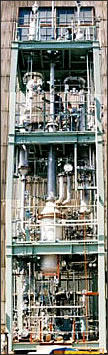
High quality is being demanded in many fields nowadays and so in order to satisfy that we developed a high-purity distillation system in collaboration with Ube industries, Ltd. and Kanto Chemical Co., Inc. The system is used to refine cleaning solutions for the semiconductor industry, medical materials, etc. of high purity (residual ion concentration: 0.01 to 1.0 ppb).
- Our High-purity distillation system provide our clients with high solvent recovery rate, almost 100%.
- The quality of the products/output from our system is very stable, which makes production management very easy, and easier than the conventional ion exchange resin method.
- No emission of waste brings our clients reduction of running cost for environmental measures.
- Our various devices minimize entrainment.
- To prevent the elution of metal, you could ask us the system made of Teflon.
- Our High-purity distillation system has been already proved for solvents that trigger very rapid decomposition reactions, such as hydrogen peroxide.
- Product guide
- Alcohol distillation
- Distillation equipment
- High-purity distillation system
- Membrane separation type solvent dehydration system
- Reactor
- Evaporative concentration equipment
- Coulter spray dryer
- Microwave treatment system
- Filter dryer
- OS filter (continuous vacuum rotating filter)
- Hydrocyclone (liquid cyclone)
- Thermal oil heater (heat medium boiler)
- Process air heater (air heater)
- Ammonia treatment system
- Catalytic deodorizing equipment for ammonia and VOC gas
- Stationary cryogenic storage tank
- Portable cryogenic container
- Cryogenic liquefied gas evaporator